
I’m delighted to welcome author David Atkinson to What Cathy Read Next today. David’s novel Future Proof was published in 2023 and is pitched as ‘a bumpy, fun-filled ride of what ifs and second chances’. The book has received positive reviews with readers variously describing it as ‘a joyous, life-affirming rollercoaster of a tale’, ‘different, and funny, and clever’ and ‘a fantastic story with many twists and turns’.
Future Proof is available to purchase now in all formats, including audiobook. And it has an accompanying original musical soundtrack, of which more later.
Read on as I chat to David about how the 800-year-old head of William Wallace sparked the idea for the book (yes, really) and why an Excel spreadsheet is his vital writing tool.
About the Book

What would you do if you could go back in time and change your life? Which regrets and mistakes would you fix? What would your life look like now?
In Future Proof an experimental medical treatment goes wrong which allows Sam Harris to do exactly that. He starts by standing up to the kids who bullied him at school and then sets about trying to fix the mess he made of the rest of his life.
However, as he discovers, changing his past doesn’t always guarantee a brighter future.
Find Future Proof on Goodreads
Q&A with David Atkinson, author of Future Proof
Q. How did you come up with the concept for Future Proof?
It came about during research for another book I was working on, delving into the murky world of genetics, specifically the DNA obtained from the 800-year-old head of William Wallace. It was here I discovered the concept of epigenetics, which is essentially the manipulation of the human genome to try to cure trauma. The idea is the geneticist can identify genes that were ‘damaged’ earlier in life and effectively ‘switch them off’ to cure mental health issues. It was this that gave me the idea of the treatment; instead of going in and fixing the earlier damaged gene, the patient would go back and experience the part of his life where the trauma occurred. There was quite a lot of science in early drafts but the feedback I got said it was dull so I pared it right back.
Q. Give us a brief pen picture of the book’s main character, Sam Harris.
Sam is one of life’s victims. Due to things that have happened to him, he’s essentially dysfunctional and unable to care for himself properly. This is where we first meet him; broke, overweight, mentally fragile and vulnerable. His early life was marked by being bullied, and I drew on things that happened to me personally to depict this.
Sam is swept along on the tide of the trips back in time with, initially, very little control over what happens. The one constant is his unshakeable love for Luci, whom he first meets as a kid in school. Luci is the rock he anchors himself to. I do put poor Sam through the mill, but he wins in the end.
Q. Apart from Sam, who was your favourite character to write?
It has to be Luci. She took on a life of her own, and I had to rein her in, as she kept wanting to go off and do things that had nothing to do with the story. In a way, Luci should get equal billing with Sam, even though it is told from Sam’s point of view. I don’t mind admitting I fell in love with Luci as the story went along. When these guys live inside your head from day to day, you find yourself being pulled back into their world, even though you know it’s not real. Luci’s world is a pretty good place to be.
Q. Author George R.R. Martin is quoted as saying, ‘There are two kinds of writers. There are architects and gardeners. The architects do blueprints before they drive the first nail. The gardeners just dig a hole and plant the seed and see what comes up.’ Which are you?
I sketch out a rough guideline in an Excel spreadsheet of who everyone is, what they do in the story and whether they’re a leading character. I give them numbers: (1) Major characters (2) Secondary characters (3) Minor characters. I then add a timeline (not so easy in time-travel fiction) and a short note of the main events. I always know my ending before I start.
Q. What’s your favourite and least favourite part of the writing process?
My favourite is the first draft when you’re not worrying about spelling, grammar, or structure, but just getting the story down on the page. My least favourite part is, not as most people would expect, editing and fixing structural and continuity issues, but rewriting. By the time I’m at my fifth rewrite, I’m fed up with the characters and the story as I know it so well. Future Proof was the exception. I found I could add layers of stuff as I went along, most of which readers may well never notice or appreciate, but which added depth to the backstory and characters. I will do this with every story from now on.
Q. There’s an album to accompany Future Proof. Can you tell us a bit more about that?
At the time, I was working on some songs for another project (I write and produce music as a hobby) but it didn’t go anywhere. I thought I’d repurpose some of the songs and make an album to accompany the book. One of the big issues I had was finding a female vocalist – many of the pieces were written for one. After scouring the internet and auditioning singers, I came across Luci Riva from Argentina, who was perfect. The fact she had the same name as my heroine is one of life’s weird coincidences! The songs are on the leading streaming platforms including Spotify and Apple Music.
Q. What are you working on next?
I’m working on three projects. Quiet Kisses is a romantic comedy utilising William Wallace’s head (as mentioned above) which should be out next summer. Secondly I’m about 60k words in to a follow-up to Future Proof called Future Perfect. I’m hoping to get that out next year too. Finally there’s a book with the working title Under The Ice which will be something of an epic and utterly different to anything I’ve done before. Who knows when that will be finished!
About the Author
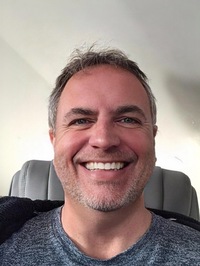
David Atkinson is an Edinburgh based writer. His first romantic comedy Love Byte was published by Buried River Press (Joffe Books) and was shortlisted for a Romantic Novelists’s Association award. The follow up Squeezed was well received as was The Second Live of Nathan Jones published in 2019 by One More Chapter, an imprint of Harper Collins.
Connect with David
Goodreads | Facebook

 What Cathy Read Next...