
About the Book
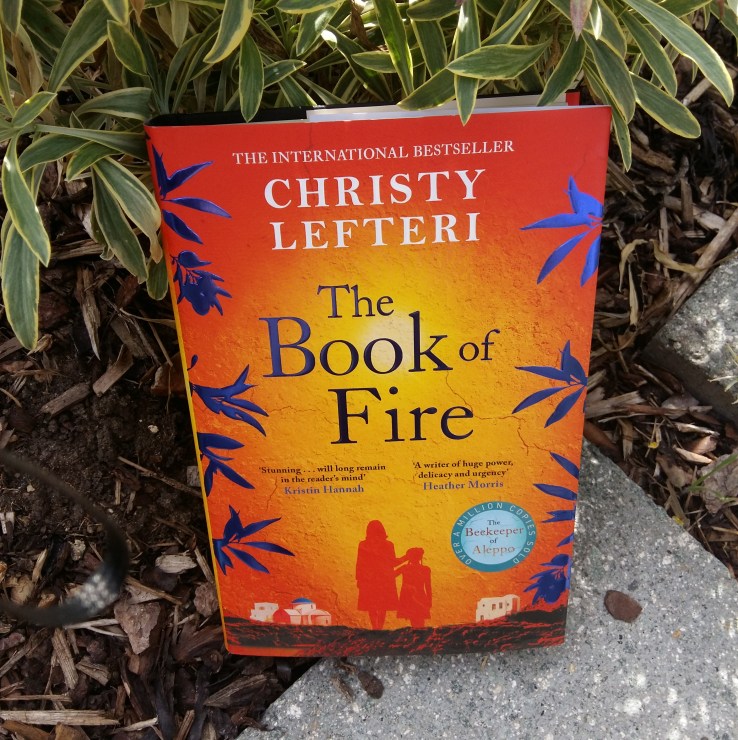
Once upon a time there was a beautiful village that held a million stories of love and loss and peace and war, and it was swallowed up by a fire that blazed up to the sky. The fire ran all the way down to the sea where it met with its reflection.
A family from two nations, England and Greece, live a simple life in a tiny Greek Irini, Tasso and their daughter, lovely, sweet Chara, whose name means joy. Their life goes up in flames in a single day when one man starts a fire out of greed and indifference. Many are killed, homes are destroyed, and the region’s natural beauty wiped out.
In the wake of the fire, Chara bears deep scars across her back and arms. Tasso is frozen in trauma, devastated that he wasn’t there when his family most needed him. And Irini is crippled by guilt at her part in the fate of the man who started the fire.
But this family has survived, and slowly green shoots of hope and renewal will grow from the smouldering ruins of devastation.
Format: Hardback (342 pages) Publisher: Manilla Press
Publication date: 17th August 2023 Genre: Contemporary Fiction
Find The Book of Fire on Goodreads
Purchase links
Bookshop.org
Disclosure: If you buy a book via the above link, I may earn a commission from Bookshop.org, whose fees support independent bookshops
Hive | Amazon UK
Links provided for convenience only, not as part of an affiliate programme
My Review
The Book of Fire has a strong environmental message. Even before the fire that devastates part of the island, Irini’s father-in-law Lazaros has warned of the damage being done by human activity as a result of global warming. ‘The entire earth is changing, we have neglected our home, Irini.’
The way in which the terrible consequences of the fire are conveyed is one of the most powerful elements of the book. There are the physical scars left on those burned whilst trying to escape from the fire, such as Irini’s daughter Chara and her husband Tasso. There are the mental and emotional scars of those who lost loved ones, whose homes were destroyed or livelihoods damaged. In one particularly affecting scene, Irini visualises the people no longer in their accustomed places in the village cafe. ‘Maria’s is the only place in the world where you don’t have to ask people how they got burnt, where their scars came from.’
And, as Irini observes on her daily walks, the fire has turned the forest from a place of beauty, teeming with life, to a place without life. ‘Death scattered all around. Death beneath my feet: the ashes of insects and animals and leaves, the ashes of colour, of a million greens and a million browns, the ashes of sounds, of scuttling and sighing, of rustling, of birdsong.’
I particularly liked the tender and loving relationship between Irini and Tasso, as Irini patiently waits for signs that the mental anguish he is suffering due to the events on the night of the fire might diminish and show the first signs that he is returning to the man he once was. Irini’s fierce protectiveness towards her daughter, badly burned in the fire, is also touching.
I was less a fan of the structure of the book in which the narrative alternates between Irini’s first person description of events before and after the fire, including her first meetings with Tasso as a child visiting her grandparents, and chapters entitled ‘The Book of Fire’ written by Irini as a kind of journal in a style that resembles a fable. The entries gradually reveal Irini’s and Chara’s experiences on the night of the fire but are written in the third person with the descriptions ‘the mother’ and ‘the daughter’ replacing their names. Much of the story we already know, for instance that Irini, Chara and Tasso survive the fire, meaning there is very little sense of jeopardy and it feels a little repetitious.
The most interesting part for me of ‘The Book of Fire’ sections is the story ‘the mother’ tells ‘the daughter’ while they wait to be rescued. It describes her own family’s history, including the forced exodus of Greeks from Turkey in the 1920s which led to her great-grandfather’s arrival in Cyprus. You don’t have to be a genius to think of modern day comparisons when Irini’s great-great-grandfather observes to his son: ‘It is dangerous to see things in black and white, even – and maybe especially – during troubled times… Each side hates each other because of memories and traumas on both sides, some are real and some are imagined, and those become national narratives. They demonise each other. The “other” is always to blame and it fuels people and groups and governments with fire. This never leads to any good on this earth.’
The book’s other plotline involving the man responsible for starting the fire explores the nature of revenge, whether it can ever be justified and whether it can actually bring the peace they desire to those who seek it. If it was the author’s intention that the reader have conflicted feelings about the rightfulness of the actions of Irini and others, then she succeeded.
Despite the terrible events that take place in the book, there are glimpses of hope, whether that’s the giant chestnut tree whose unburned half shows sign of life, the recovery of a young jackal rescued from the forest or the simple action of someone lifting a cup to their mouth by themselves for the first time.
I received a review copy courtesy of Manilla Press via Readers First.
In three words: Emotional, intense, thought-provoking
About the Author

Brought up in London, Christy Lefteri is the child of Cypriot refugees. Her novel, The Beekeeper of Aleppo, is an international bestseller, selling well over a million copies worldwide and published in over 40 countries. It won The Aspen Literary Prize, was runner up for The Dayton Literary Prize and won the Prix de l’Union Interalliée for Best Foreign novel in France. It is currently being performed as a play, adapted by Nesrin Alrefaai and Matthew Spangler, for The Nottingham Playhouse, and touring the UK. Songbirds, her follow up novel, was a Sunday Times and international bestseller. (Photo: Twitter profile)
Connect with Christy
Twitter

 What Cathy Read Next...
Our library has just got this, Cathy. I think I need to place a hold on it. Great review. 💕📚
LikeLike