Buchan of the Month: Introducing…John Burnet of Barns by John Buchan

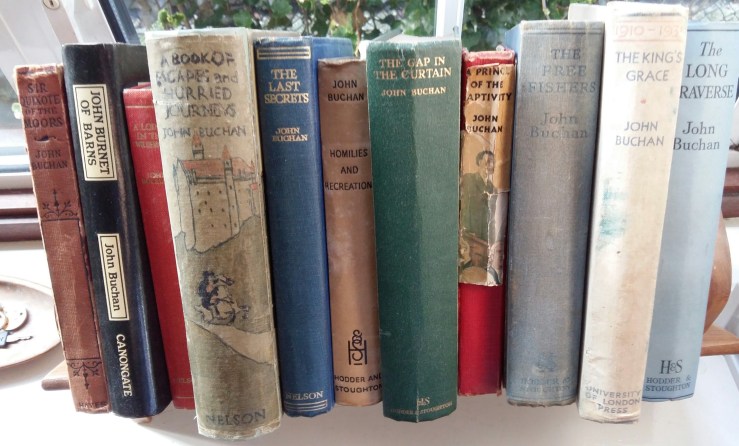
February’s Buchan of the Month is John Buchan’s first full-length novel, John Burnet of Barns. (His first published novel, Sir Quixote of the Moors, was reviewed last month.) You can find out more about the project and my reading list for 2020 here.

John Burnet of Barns was published by John Lane on 3rd June 1898, although it had first appeared in serial form in Chamber’s Journal between December 1897 and August 1898.

Buchan’s first biographer, Janet Adam Smith, reports Buchan had begun to collect notes for this ‘novel of Tweeddale’ in 1894 with the intention of starting to write it the following summer. By the time he was at Brasenose College, Oxford in 1895, the novel was nearly finished, he had taken on a literary agent and had three publishers interested in it: Blackwood, Fisher Unwin and John Lane. He received a £100 advance from John Lane, the book’s eventual publisher in the UK.

Like Sir Quixote of the Moors, John Burnet of Barns is written in the first person and set in 17th century Scotland at a time of political and religious turmoil. However, its hero is not a French knight (as in Sir Quixote) but a boy from Tweeddale with, as Janet Adam Smith notes, interests and experiences very similar to Buchan’s own, namely ‘a taste for fishing and philosophy and long excursions into the hills’. She also points to characteristics that would feature in later Buchan novels, such as the hero being a ‘passionate moderate’ and his hatred for his enemy being tempered by a degree of admiration (see John Laputa in Prester John or Dominick Medina in The Three Hostages).

However, Janet Adam Smith notes that Buchan himself was rather ashamed of the book, later describing it as a ‘hotch-potch’ and ‘very immature and boyish’. Although conceding the book has some of the same faults as Sir Quixote of the Moors, David Daniell is rather more generous describing it as ‘a fine book for a first long novel’ and commenting that if it is a ‘hotch-potch’ it is at least a fascinating one.

No sales figures are available for the original edition of the book or the shilling edition published by John Lane in 1916 but, by the time Janet Adam Smith’s biography of John Buchan was published in 1965, the paperback edition published by Pan in 1952 had sold 30,000 copies.

David Daniell sums up John Burnet of Barns as ‘a clever, searching analysis of non-commitment done with a good deal of novelistic skill’. Look out for my review later this month to see if I agree.

Sources:

Janet Adam Smith, John Buchan: A Biography (OUP, 1985 [1965])
David Daniell, The Interpreter’s House: A Critical Assessment of John Buchan (Nelson, 1975)
Kenneth Hillier and Michael Ross, The First Editions of John Buchan: A Collector’s Illustrated Biography (Avonworld, 2008)
20200205_130743-1

#BookReview 355: The Women of Washington’s Spy Ring by Kit Sergeant

355 The Women of Washington's Spy RingAbout the Book

Who was the mysterious 355?

Culper Ring members such as Robert Townsend and Hercules Mulligan are well known for the part they played in the Revolutionary War, but who was the mysterious 355 that could “outwit them all?” Inspired by many of the same characters featured in AMC’s Turn and the Broadway musical Hamilton, 355: The Women of Washington’s Spy Ring chronicles the lives of three remarkable women who use daring, skill, and, yes, a bit of flirtation, to help liberate America.

Told from the viewpoints of these three women, including the one operating under the code name 355, 355: The Women of Washington’s Spy Ring is an absorbing tale of family, duty, love, and betrayal.

Format: ebook (332 pages)                        Publisher: Thompson Belle Press
Publication date: 12th December 2017  Genre: Historical Fiction

Find 355: The Women of Washington’s Spy Ring (Women Spies Book 1) on Goodreads

Purchase links*
Amazon.co.uk | Amazon.com
*links provided for convenience, not as part of any affiliate programme


My Review

Firstly, I’d recommend not reading the book description on Goodreads as, to my mind, it gives away too much of the story. (The blurb above is my edited version.) Secondly, I feel this book will be most appreciated by those with some knowledge of the American Revolutionary War and the key characters involved. Unfortunately, as a Brit, I don’t fall into that category so, as well as having never heard of the Culper Ring, I found myself confused at times by who was on what side, especially as various terms were used for the supporters of each faction – Whigs, Tories, Loyalists, rebels – and, of course, people supporting one side might be masquerading as supporting the other or switch sides!

The book opens with a prologue set in 1939 that recreates amateur historian, Morton Pennypacker, receiving important information in his search for the identity of all the members of the Culper spy ring. I must admit I thought this was an unnecessary bit of whimsy on the part of the author until I read the Bibliography and the Author’s Note at the end of the book.

After that the book switches frequently between the points of view of three real life women: Margaret (Meg) Moncrieffe, the daughter of a British naval captain; Elizabeth Burgin, the wife of a man captured and imprisoned by the British; and Sarah (Sally) Townsend, the eldest daughter of a Quaker family, supporters of the drive for Independence.

Covering the years from 1776, the book recounts how the three women become involved in espionage, each for different reasons. For Meg, it’s in an attempt to end the war to protect the lives of her father and the man she has fallen in love with, fighting on the opposite side. For Elizabeth, it’s the desire to help men in the same position as her husband. For Sally, it’s all about the cause of independence.

I liked the way the book showed how women played a role in the outcome of the conflict in the only ways open to them: using a little flirtation to gather information, observing troop movements, acting as couriers for secret messages. To get a flavour of this, you can read an extract from the book here. Of the three, I found Elizabeth’s story the most interesting and engaging because of the more active nature of her involvement and the ingenuity she showed.

Although the women may not have been on the front line it was a dangerous game with serious consequences for those found guilty of spying. I liked that the epilogue provides information about what happened to the three women after the book ends.

And the identity of 355? The author makes her choice (and provides her reasons for it in her Author’s Note) but you’ll have to read the book to find out what it is!

Thanks to the author for my review copy and her patience in waiting for it to reach the top of my review pile.

In three words: Engaging, dramatic, detailed

Try something similar: The Midwife’s Revolt by Jodi Daynard

Follow my blog via Bloglovin


Kit SergeantAbout the Author

Like her character Addy in Thrown for a Curve, Kit has a practically useless degree in marine biology. A teacher by profession and at heart, Kit loves to impart little-known facts and dares you to walk away from one of her books without learning at least one new thing. She has written a few “beach reads” with intelligent and strong female leads. One of them, What It Is, was a previous Kindle Scout winner.

Her newest book, 355: The Women of Washington’s Spy Ring, keeps the strong heroines that are essential to Kit’s books, but takes them back 240 years, to the genesis of America and the women who helped spawn it.

Connect with Kit
Website | Twitter | Facebook | Goodreads