

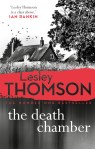
I’m thrilled to be co-hosting today’s stop on the blog tour for The Death Chamber by Lesley Thomson, the sixth instalment in the bestselling The Detective’s Daughter series. I took part in the blog tour for the previous book in the series, The Dog Walker, featuring a fascinating Q&A with Lesley. I’m delighted that Lesley has agreed to answer some more of my questions and I’m sure you will find her answers this time equally fascinating.
 About the Book
Queen’s Jubilee, 1977: Cassie Baker sees her boyfriend kissing another girl at the village disco. Upset, she heads home alone and is never seen again.
Millennium Eve, 1999: DCI Paul Mercer finds Cassie’s remains in a field. Now he must prove the man who led him there is guilty.
When Mercer’s daughter asks Stella Darnell for help solving the murder, Stella sees echoes of herself. Another detective’s daughter. With her sidekick sleuth, Jack, Stella moves to Winchcombe, where DCI Mercer and his prime suspect have been playing cat and mouse for the past eighteen years…
Format: ebook, hardcover (448 pp.) Publisher: Head of Zeus
Published in UK: 5th April 2018 Genre: Crime
Pre-order/Purchase Links*
Publisher website ǀ Amazon.co.uk ǀ Amazon.com ǀ Hive.co.uk (supporting UK bookshops)
*links provided for convenience, not as part of any affiliate programme
Find The Death Chamber on Goodreads
Interview with Lesley Thomson, author of The Death Chamber (The Detective’s Daughter #6)
Without giving too much away, can you tell me a bit about The Death Chamber?
The story’s based on an early Neolithic Long Barrow above Winchcombe, a village in the Cotswolds where Victorian archaeologists found 31 bodies. In my novel, on the last day of 1999, the police discover another body. An eighteen-year-old woman who vanished from the village 22 years earlier. Her murder remains unsolved. The discovery is made during the hunt for another young woman also presumed dead. A cloud of suspicion hangs over the village. Someone is guilty, but who?
Set in the countryside, there’s a ruined house, a remote cottage with no electricity and a wandering scarecrow. Jack and Stella are city people, who take solving a murder in their stride, but negotiating fields and stiles is a challenge. All in all, I hope these are ingredients for a pretty scary story!
The Death Chamber is the sixth book in The Detective’s Daughter series. How do you approach balancing the needs of readers who have followed the whole series and those reading The Death Chamber as a standalone book?
I take a tip from The Archers of which I’m a diehard fan. The writers create drama that doesn’t depend on knowing the back story to draw in the listener. Equally they mention past events (60 years ago sometimes!) that reward us die-hard listeners.
When I arrive late on in a series, I enjoy going back and starting at the beginning to see how characters got to where they are. I write novels with this in mind. There will be references that new readers won’t get, but I hope not to baffle and divert. I specifically consider how experience has shaped my characters, as it does us. Not mentioning previous events is to foist amnesia on Jack or Stella. Unlike Miss Marple (who I love), they age and develop with each novel.
In The Death Chamber, Stella has another cold case to investigate; this time one dating back over twenty years to the Queen’s Jubilee in 1977. Do you enjoy the challenge of recreating events and evoking the atmosphere of the past?
I’m interested in exploring the repercussions of murder. What happens to the people affected? How do they go on with their lives? To do this, I can set a murder in the past. So far I’ve written about eras that were once my present. Although not a historian per se, I have to say it’s unsettling to admit that 1977 is history! I do enjoy revisiting the clothes, music and tastes of that time – although not the flares!
How has your lead character, Stella, changed over the course of the series?
In the first novel, Stella can be uptight. It’s giving nothing away to say that her dad has a heart attack at the start of the story and from then on she’s dealing with the aftermath of his death. She’s rubbish at grief! A woman of action, who is soothed by cleaning – the deeper the better – she gets on with life. Gradually, over the course of each novel, as she and Jack get closer, Stella opens up. I expressed this change by never writing ‘Stella felt’ or ‘Stella imagined’ in the first couple of novels. Now she’s feeling and imagining all the time.
The Death Chamber is an arresting title. At what point in the writing process do you come up with the title for a book and to what extent is it a collaborative process?
Titles are not my thing. The only one I’ve come up with was The Dog Walker and even then I wasn’t sure. Laura, my editor insisted it was great. Then take my title for The Detective’s Daughter. In homage to Katherine Mansfield’s ‘The Daughters of the Late Colonel’, I’d called it ‘The Daughter of the Late Detective’. Yeah okay! I’m grateful to my agent Georgina for changing that one. The House With No Rooms was ‘The Detective’s Shadow’ until Laura thankfully stepped in again. I still get emails from readers who’ve tried to find The Detective’s Shadow. It truly is a ‘ghostly’ book. I credit the wonderful crime writer Elly Griffiths with The Death Chamber. Now, she’s great on titles!
Your book, A Kind of Vanishing, featured minor characters that appeared in the first book in the series, The Detective’s Daughter. Is this something you might repeat?
If I feel a character has more to do, yes. Mrs Ramsay found her way into The Detective’s Daughter because she fascinated me. A complex woman – beautiful in her youth, washed up and lonely in her old age – I’m still drawn to her. She also features in my short story ‘The Runaway’ about Stella aged seven. However, I’m about to write a standalone novel in which none of my previous characters will feature.
I know you teach creative writing. Have you been tempted (or courageous enough) to invite your students to critique your own writing?
Yes absolutely. I teach on an MA and in a session on suspense students have discussed chapter eight in The Detective’s Daughter. They came up with insightful and considered ideas, making connections and seeing resonances that I hadn’t thought of. I hope they also saw how, while writers are conscious of much they put on the page, levels emerge in the storytelling that they didn’t plan, yet still work.
What makes the partnership between Stella Darnell and her sidekick, Jack Harmon, so successful?
I think it’s that old chestnut that opposites attract. Stella, as I said, is all about getting things done, she’s rational and logical. Stain by stain is her motto, when cleaning but also as a detective. Jack is fanciful and whimsical. He believes in ghosts and is always seeing signs and drawing conclusions from them. This has confounded Stella, but with each novel she’s a little more drawn in. She too spots deeper meanings in personalised number plates. Their differing skills make them the perfect team.
Are there elements of Stella’s character that you recognise in yourself? For instance, are you fond of cleaning?
Hah, so not! My mum always said how cleaning was therapeutic and Stella – if she thought in such terms – would probably agree. I’ve never really got that. Although when I do clean – in the manner of Stella, stain by stain – I get into every nook and cranny. The thing is I’m dumbfounded when, having gone through the house, eradicating dust, like the washing up, it comes back. However, like Stella, I love compiling spreadsheets and eat too many ready meals.
What are you working on next?
I’m on the seventh in The Detective’s Daughter series. It’s called The Playground Murders – a title that I thought of and wasn’t sure worked but which Laura liked. So, no change there. In this one Jack and Stella are working on a murder case that was only a couple of years before, so barely cold. However the story will take us back to December 1980, the month that John Lennon was shot when we’ll meet Stella’s dad as a young man.
Thanks for those fascinating answers, Lesley. Fans of the series will be thrilled by the news of another instalment…and by the prospect of meeting Stella’s dad.
 About the Author
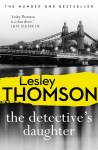
Lesley Thomson grew up in west London. Her first novel, A Kind of Vanishing, won the People’s Book Prize in 2010. Her second novel, The Detective’s Daughter, was a #1 bestseller and sold over 500,000 copies. Lesley combines writing with teaching creative writing. She lives in Lewes with her partner.
Connect with Lesley
Website ǀ Facebook ǀ Twitter ǀ Instagram ǀ Goodreads



 What Cathy Read Next...
This sounds great and I enjoyed the interview. But I have to protest – 1977 is not history! I’ve made it a law that no-one is allowed to call any year I actually remember “history”, OK? 😉
LikeLiked by 1 person
Good point – I remember 1977 as well! The Walter Scott Prize for Historical Fiction set sixty years as their benchmark so I think we can say 1977 is in the past but not yet history…
LikeLiked by 1 person