Book Review: The Vanishing of Audrey Wilde by Eve Chase

TheVanishingofAudreyWildeAbout the Book

From the present day…Applecote Manor captivates Jessie with it promise of hazy summers in the Cotswolds. She believes it’s the perfect escape for her troubled family. But the house has an unsettling history, and strange rumours surround the estate. To the fifties …When teenage Margot and her three sisters arrive at Applecote during the heat wave of ’59, they find their aunt and uncle still reeling from the disappearance of their daughter Audrey five years before.  The sisters are drawn into the mystery of Audrey’s vanishing – until the stifling summer takes a shocking, deadly turn. Will one unthinkable choice bind them together, or tear them apart?

Format: ebook Publisher: Michael Joseph Pages:
Publication: 13th July 2017 Genre: Historical Fiction

Purchase Links*
Amazon.co.uk ǀ Amazon.com ǀ
*links provided for convenience, not as part of any affiliate programme

Find The Vanishing of Audrey Wilde on Goodreads


My Review

From the opening chapter, there is an absorbing atmosphere of mystery that the author skilfully maintains throughout the book. Alternating between past and present, there are subtle links, echoes and common themes in both stories.   Often, in a dual time narrative such as this, I find myself more drawn to the parts set in the past. However, in this case, I felt equally engaged in both stories.

Despite her unexplained disappearance five years earlier, Audrey is a constant, silent, almost ghostly, presence in the story set in the past.

‘There’s a patter of small footsteps. A swing of plait. A flick of yellow ribbon. Something pulls at the edges, a darkness that no one dare name.’

Similarly, Will’s first wife, Mandy, exerts a similar influence on the story set in the present. There are with echoes of Daphne du Maurier’s Rebecca in Jessie’s fixation with her predecessor, so much more stylish and accomplished she imagines than she is.  But of course, the second Mrs de Winter never had to deal with a rebellious step-daughter. In fact, Jessie’s sense that she can never live up to Mandy in the memories of her step-daughter and husband, form a barrier and blind her to what is really going on.  Every set back, Jessie interprets as a sign of Mandy’s ‘triumph’ from beyond the grave.

There is lovely descriptive writing about the countryside that conjures up an idyllic summer that seems somehow frozen in time: ‘The river drifts lazily ahead, twisting gently, wide as a country lane, willow trees kissing the cloudy green surface.’ However, beneath the idyll there are hints of danger, secrets and mystery.

I enjoyed the way the book explored themes of identity. For instance, how Audrey and Margot looked similar, could be mistaken for each other even and the effect this has on Margot and others around her.

‘I ask myself, what would Audrey do right now if she were me, and I her, and our fates had been swapped, like straw boaters, as they so easily might have been in the jumble of the last days of summer?’

Or the way in which the bond between Margot and her sisters – so strong in the beginning, almost telepathic – starts to unravel. Margot even starts to envy Audrey her status as an only child, seeing her as ‘a sweet-sharp cordial undiluted by siblings’. Similarly, Jessie’s hope that the move to Applecote will help the family come together seem precarious, as if the house is determined that the secrets of the past must emerge.

‘She wonders about the other thing lying dormant at Applecote, waiting for the right conditions to come alive.’

In the slow unveiling of the facts behind Audrey’s disappearance, the author certainly sent this reader up a few dead ends. I enjoyed the author’s previous book, Black Rabbit Hall, but thought this was even better.

I received an advance reader copy courtesy of NetGalley and publishers, Michael Joseph, in return for an honest review.

Follow my blog with Bloglovin

In three words: Dark, suspenseful, atmospheric

Try something similar…The Secret Keeper by Kate Morton


EveChaseAbout the Author

Eve Chase is the pseudonym of a journalist who has worked extensively across the British press.  Eve Chase always wanted to write about families – ones that go wrong but somehow survive – and big old houses, where family secrets and untold stories seed in the crumbling stone walls. She lives in Oxford, England with her husband and three children.

Connect with Eve

Website ǀ Facebook ǀ Twitter ǀ Goodreads

BookConnector


Throwback Thursday

ThrowbackThursday

Throwback Thursday is a weekly meme hosted by Renee at It’s Book Talk.  It’s designed as an opportunity to share old favourites as well as books that we’ve finally got around to reading that were published over a year ago. If you decide to take part, please link back to It’s Book Talk.


I’ve decided to delve back into the earliest days of my blog (not that it’s that old) and share one of my first reviews. It’s for a collection of short stories by Katherine Mansfield, an author I was introduced to whilst studying for my Masters with The Open University. If you like your short stories a little dark, then give this collection a try.

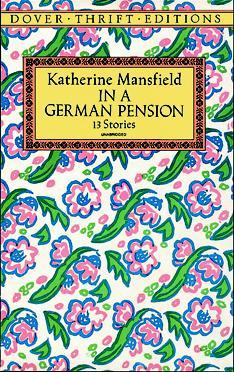
In A German Pension: 13 Stories by Katherine Mansfield

germanAbout the Book

In A German Pension was Katherine Mansfield’s first published collection of short stories. The stories were inspired by her stay at the Villa Pension Müller in the Bavarian spa of Bad Wörishofen in 1909.

Purchase Links*
Amazon.co.uk ǀ
*links provided for convenience, not as part of any affiliate programme

Find In A German Pension: 13 Stories on Goodreads


My Review

The stories in this collection are divided between vignettes of guests staying at the Pension, which are gently mocking in tone, and much darker stories that often have a sting in the tail. A frequent theme of the latter is the social and sexual oppression of women.

In “German Meat”, the female English narrator is a sardonic commentator on the coarseness of the German guests who are constantly eating, perspiring and discussing their ailments and bodily functions. They, however, believe themselves superior to the English, particularly when they learn the narrator does not know what kind of meat her husband likes and, worse still, admits to being vegetarian. Mansfield deftly conveys the guests’ greed and grotesque habits in a few short sentences.

‘A glass dish of stewed apricots was placed upon the table. “Ah , fruit!” said Fraulein Stiegelauer, “that is so necessary to health. The doctor told me this morning that the more fruit I could eat the better.” She very obviously followed the advice.’

In “The Sister of the Baroness”, Mansfield exposes the snobbery of the other guests who cannot contain their excitement at the prospect of a relative of a wealthy member of the nobility staying at the Pension.

‘Coffee and rolls took on the nature of an orgy. We positively scintillated. Anecdotes of the High Born were poured out, sweetened and sipped: we gorged on scandals of High Birth generously buttered.’

Unfortunately their fawning regard for the new arrival turns out to be misplaced when it is revealed she is merely the daughter of the Baroness’s dressmaker.

In “The Advanced Lady”, the pretensions to intellectual superiority of a lady writer are lampooned.

‘“But Love is not a question of lavishing,” said the Advanced Lady. “It is the lamp carried in the bosom touching with serene rays all the heights and depths of…” “Darkest Africa,” I murmured flippantly. She did not hear.’

Amongst the darkest of the stories is “The Child Who Was Tired”, which recounts the unrelenting toil of a young girl and the dreadful act she is driven to by despair and exhaustion. Another notable story is “Frau Brechenmacher Attends a Wedding” in which the conventions of domestic bliss are satirised both in the descriptions of the pompous Herr Brechenmacher and the events of the wedding breakfast. The bride is described as having the appearance of “an iced cake, all ready to be cut and served in neat little pieces to the bridegroom beside her”. There is a sense of violence underpinning the story which is realised in the final sentence.

Although Mansfield later came to regard this early collection of stories as having little merit, I enjoyed the precision of the writing and their dark humour.

mansfieldAbout the Author

Katherine Mansfield was born in New Zealand in 1888 and is widely considered the best short story writer of the modernist period. She left New Zealand for the UK when she was 19 and then travelled for a time in Europe. She was associated with a “new dawn” in English literature and together with T.S. Eliot, James Joyce and Virginia Woolf made the London of the period the centre of the literary world. Mansfield’s stories were written without a conventional plot but concentrated on one moment, a crisis or turning point rather than a sequence of events. Often very dark, common themes of her stories include human isolation, the conflict between love and disillusionment, idealism and reality. Katherine Mansfield died in 1923 at the age of only 34.