
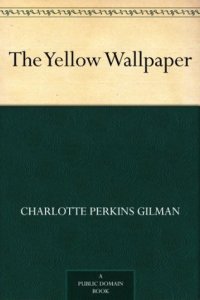
 About the Book
First published in 1892, The Yellow Wallpaper is written as the secret journal of a woman who, failing to relish the joys of marriage and motherhood, is sentenced to a country rest cure. Though she longs to write, her husband and doctor forbid it, prescribing instead complete passivity. In the involuntary confinement of her bedroom, the hero creates a reality of her own beyond the hypnotic pattern of the faded yellow wallpaper – a pattern that has come to symbolize her own imprisonment. Narrated with superb psychological and dramatic precision, The Yellow Wallpaper stands out not only for the imaginative authenticity with which it depicts one woman’s descent into insanity, but also for the power of its testimony to the importance of freedom and self-empowerment for women.
| Format: | ebook | Publisher: | Pages: | 29 | |
| Publication: | [1892] | Genre: | Short Story |
Purchase Links*
Amazon.co.uk ǀ
*links provided for convenience, not as part of any affiliate programme
Find The Yellow Wallpaper on Goodreads
My Review
The Yellow Wallpaper forms part of my Classics Club Challenge.
This short story certainly punches above its weight. It has an air of underlying menace that is quite chilling. The house itself contributes to this:
‘Still I will proudly declare that there is something queer about it. Else, why should it be let so cheaply? And why have stood so long untenanted?’
Although there are elements of a horror story – the house no-one wants to rent, the wallpaper with its strange pattern, the barred windows, the feeling of being under constant observation – it is really an unnerving account of mental disintegration. The author forces the reader to question whether the narrator’s husband is really interested in his wife’s welfare and anxious for her recovery or using her condition to exercise control over her.
‘He is very careful and loving, and hardly lets me stir without special direction.’
And is their room really a former nursery, with its barred windows, peeling wallpaper, rings in the walls and heavy bedstead fixed to the floor? Or has it had, does it still have, a more sinister function?
The book exposes the distorted attitude to mental illness of the time (particularly women’s mental illness) – that the person just needs to exercise more self-control, to pull them self together to overcome it. The narrator’s husband dismisses his wife’s feeling of repulsion toward the wall-paper out of hand:
‘..He said that I was letting it get the better of me, and that nothing was worse for a nervous patient than to give way to such fancies.’
In the end, the narrator’s disintegration is complete and shocking, even more so because the story is semi-autobiographical, written while the author was suffering from what we would now recognise as post-natal depression.
In three words: Chilling, unsettling, dark
Try something similar…The Pit and the Pendulum by Edgar Allen Poe
 About the Author
Charlotte Perkins Gilman was a prominent American sociologist, novelist, writer of short stories, poetry, and non-fiction, and a lecturer for social reform. She was a utopian feminist during a time when her accomplishments were exceptional for women, and she served as a role model for future generations of feminists because of her unorthodox concepts and lifestyle.




 What Cathy Read Next...