WWW Wednesdays 19/7/17

WWWWednesdays

Hosted by Taking on a World of Words, this meme is all about the three Ws:

  • What are you currently reading?
  • What did you recently finish reading?
  • What do you think you’ll read next?

Why not join in too? Leave a comment with your link at Taking on a World of Words and then go blog hopping!


Currently reading
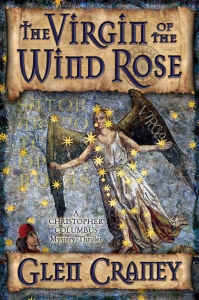
VirginoftheWindRoseThe Virgin of the Wind Rose by Glen Craney (review copy)

While investigating the murder of an American missionary in Ethiopia, rookie State Department lawyer Jaqueline Quartermane stumbles upon the infamous Templar Word Square, an ancient Latin puzzle that has eluded scholars for centuries. To her horror, she soon discovers the palindrome has been embedded with a cryptographic time bomb. Separated by half a millennium, two global conspiracies dovetail in this historical mystery-thriller to expose the world’s most explosive secret: the real identity and mission of Christopher Columbus.

Verdict so far: There are two stories – one set in the present and one in the 15th century.  I’m probably drawn more to the story set in the past but I’m looking forward to  how the two stories come together.
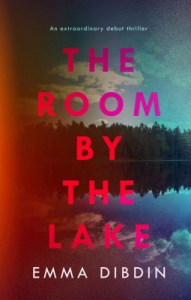
TheRoombytheLakeThe Room by the Lake by Emma Dibdin (eARC)

When Caitlin moved from London to New York, she thought she had left her problems behind: her alcoholic father, her dead mother, the pressure to succeed. But now, down to her last dollar in a foreign city, she is desperately lonely. Then she meets Jake. Handsome, smart, slightly damaged Jake. He lives off-grid, in a lakeside commune whose members practise regular exercise and frequent group therapy. Before long, Caitlin has settled into her idyllic new home. It looks like she has found the fresh start she longed for. But, as the commune tightens its grip on her freedom and her sanity, Caitlin realizes too late that she might become lost forever…

Verdict so far: I’m enjoying the complex lead character the author has created.  I’m 30% through and waiting for the ‘thriller’ bit to come to the fore…


Recently finished
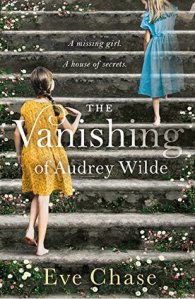
TheVanishingofAudreyWildeThe Vanishing of Audrey Wilde by Eve Chase (eARC)

From the present day …Applecote Manor captivates Jessie with it promise of hazy summers in the Cotswolds. She believes it’s the perfect escape for her troubled family. But the house has an unsettling history, and strange rumours surround the estate.  To the fifties…When teenage Margot and her three sisters arrive at Applecote during the heatwave of ’59, they find their aunt and uncle still reeling from the disappearance of their daughter Audrey five years before. The sisters are drawn into the mystery of Audrey’s vanishing – until the stifling summer takes a shocking, deadly turn. Will one unthinkable choice bind them together, or tear them apart?

Verdict: Really enjoyed this, review to come shortly
TheYellowWall-PaperThe Yellow Wallpaper by Charlotte Perkins Gilman

First published in 1892, The Yellow Wallpaper is written as the secret journal of a woman who, failing to relish the joys of marriage and motherhood, is sentenced to a country rest cure. Though she longs to write, her husband and doctor forbid it, prescribing instead complete passivity. In the involuntary confinement of her bedroom, the hero creates a reality of her own beyond the hypnotic pattern of the faded yellow wallpaper – a pattern that has come to symbolize her own imprisonment. Narrated with superb psychological and dramatic precision, The Yellow Wallpaper stands out not only for the imaginative authenticity with which it depicts one woman’s descent into insanity, but also for the power of its testimony to the importance of freedom and self-empowerment for women.

Verdict: Chilling and unsettling, read my review here


What Cathy (will) Read Next

ItWasOnlyEverYouIt Was Only Ever You by Kate Kerrigan (review copy courtesy of Head of Zeus)

Patrick Murphy has charm to burn and a singing voice to die for. Many people will recognise his talent. Many women will love him. Rose, the sweetheart he leaves behind in Ireland, can never forget him and will move heaven and earth to find him again, long after he has married another woman. Ava, the heiress with no self-confidence except on the dance floor, falls under his spell. And tough Sheila Klein, orphaned by the Holocaust and hungry for success as a music manager, she will be ruthless in her determination to unlock his extraordinary star quality. But in the end, Patrick Murphy’s heart belongs to only one of them. Which one will it be?
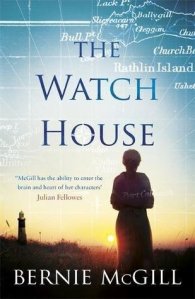
TheWatchHouseThe Watch House by Bernie McGill (eARC)

As the twentieth century dawns on the island of Rathlin, a place ravaged by storms and haunted by past tragedies, Nuala Byrne is faced with a difficult decision. Abandoned by her family for the new world, she receives a proposal from the island’s aging tailor. For the price of a roof over her head, she accepts. Meanwhile the island is alive with gossip about the strangers who have arrived from the mainland, armed with mysterious equipment which can reportedly steal a person’s words and transmit them through thin air. When Nuala is sent to cook for these men – engineers, who have been sent to Rathlin by Marconi to conduct experiments in the use of wireless telegraphy – she encounters an Italian named Gabriel, who offers her the chance to equip herself with new skills and knowledge. As her friendship with Gabriel opens up horizons beyond the rocky and treacherous cliffs of her island home, Nuala begins to realise that her deal with the tailor was a bargain she should never have struck.


 

Blog Tour: Surviving the Fatherland by Annette Oppenlander

SurvivingtheFatherlandTour

I’m delighted to host today’s stop on the blog tour for Surviving the Fatherland by Annette Oppenlander and to bring you a fascinating interview with the author about the inspiration for the book.

WinAlso, there’s a fantastic giveaway with a chance to win one of two signed copies of Surviving the Fatherland

To enter, click here


Follow my blog with Bloglovin


SurvivingtheFatherlandAbout the Book

Spanning thirteen years from 1940 to 1953 and set against the epic panorama of WWII, Surviving the Fatherland is a sweeping saga of family, love, and betrayal that illuminates an intimate part of history seldom seen: the children’s war. Surviving the Fatherland tells the true and heart-wrenching stories of Lilly and Günter struggling with the terror-filled reality of life in the Third Reich, each embarking on their own dangerous path toward survival, freedom, and ultimately each other. Based on the author’s own family and anchored in historical facts, this story celebrates the resilience of the human spirit and the strength of war children.

Format: ebook Publisher:   Pages: 355
Publication: 15th March 2017 Genre: Historical Fiction    

Purchase Links*
Amazon.co.uk ǀ Amazon.com ǀ Barnes & Noble ǀ Kobo
*links provided for convenience, not as part of any affiliate programme

Find Surviving the Fatherland on Goodreads


Interview with Annette Oppenlander, author of Surviving the Fatherland

Surviving the Fatherland is based on the experiences of your own family. When did you first learn of their story?

Growing up I always felt there were a lot of stories hidden in my family. I’d hear bits and pieces, quick references or watch my parents nod at each other in silent understanding. As my interest in history grew, my curiosity grew with it. So in 2002 I asked my parents to share their stories. I spent several weeks visiting them in Germany and recording their memories. I remember one afternoon we were in the basement while my mother ironed. I’d ask questions and she’d tell me about the way her mother treated her. I still have those tapes though it’s hard for me to hear my mother’s voice. She passed away in 2004. My mother always insisted that my father was the better storyteller. And while I agree that his activities were quite adventurous, my mother’s quieter side offered a lot of depth. And so I think the two characters balance each other out nicely.

Initially, I had planned to write short stories so my children could remember their grandparents. But then I realized there were few if any stories about Germany’s war children and the civilian side of WWII. Of course, we have excellent and moving stories about the Holocaust and the soldier’s war. There is no shortage of battle scenes. Yet, many battles were fought at home. They weren’t drawing as much attention, but they were just as heroic. I wanted to add complexity to the stereotypical portrayal of Germany in the Third Reich.

What made you decide to tell the story in the form of historical fiction?

It’s difficult to create a biography when you weren’t there to record actual conversations. My parents were young when the war started and much of what they experienced is shown through their eyes. I also wanted some freedom to create characters the reader could identify with and I wanted to tell a story with a message. So, while almost everything in the book is true, I added some characters and plot points that I felt enhanced the story.

The story is told from the point of view of two children, Lilly and Günter. What made you decide on this approach?

This novel went through dozens of revisions and rewrites. In earlier drafts I also had some chapters depicting Wilhelm, Lilly’s father in Russian gulags, her mother meeting the Baroness the first time and Günter’s father in Norway trading with Enar, the Norwegian shopkeeper. In the end I condensed to the two main characters with slightly more emphasis on Lilly. While she had the less adventurous part, she endured a lot of cruelty.

How did you go about your research for the book?

I recorded hours of interviews with my parents in 2002. After that I studied WWII and post-war Germany in detail, particularly as it pertained to Solingen. I visited the city archives several times, even found a newspaper reference to my grandfather, Wilhelm – Lilly’s father – returning home in September 1953. I read a number of books about WWII and about Russian gulags. None of the Russian experience made it into the novel, but I’m currently working on a new story about Wilhelm. I also found a lot of personal photos in my father’s cupboards.

What was the most surprising fact you came across during your research?

I had a pretty good handle on wartime Germany, but I found out some interesting information about the post-war era. For instance, between 1945 and 1948 Germany’s currency, the Reichsmark, went into free fall with runaway inflation. At the same time, people still starved which caused the need for black markets and cross-country hamster/bartering trips. Stores remained empty until June of 1948 when the Deutsche Mark (DM) was introduced. But even the night before, stores still showed signs like “out of stock, sold out or closed for remodeling.” The next morning, all stores were filled with goods of all imaginable kind: flour, butter, sugar, chocolate, camera equipment, undergarments and household goods. You name it—it was there. The introduction of the DM ended the ration system in Germany and it also ended starvation.

What was the biggest challenge you encountered when writing the book?

I think one reason why it took me 15 years to finish the novel was that I was too close to the story and quite emotionally involved. It took time to step back, hone my craft, and arrive at Lilly’s and Günter’s voices. I also struggled with the structure, i.e. whether to go chronologically or back and forth. I tried all sorts of arrangements, but ended up going with the chronological order.

When you look back on what your own family experienced during WW2, what is your overriding feeling?

I’m amazed they made it through and didn’t go crazy in the process. Especially my mother had such a horrific time. She should’ve been a basket case, but she was a very caring mother. The other feeling I experience now is gladness that I was able to get their stories told. So many readers comment how they never realized the plight of the German war children and that they learned a lot.

What is your favourite and least favourite part of the writing process?

One of the challenges is to know when to start writing. As a historical novelist one has to have a good grasp of the era, the world the story takes place in. I find myself wanting to write before I’ve done all the necessary research. It is a fine line to walk.

Which other writers do you admire and why?

I admire many authors for various reasons. Some are/were quite prolific, others have written profound stories, even classics. Reading these stories has somehow informed my life and my writing. Many have touched me emotionally. Here are a few in no particular order: Stephen King, Ken Follett, Harper Lee, James Alexander Thom, Mark Twain, Jane Austen, Charles Dickens.

What are you working on next?

As I mentioned I’m currently researching WWII from the German soldiers’ perspective. I’m getting in touch with the German military government to see if any records exist of my grandfather. This way I could place him exactly in the right unit. If I find what I’m looking for, I’ll write a novel about Wilhelm in the war and his nine years as a POW in Russia. I recently finished Broken Journey, a story set during the American Civil War. It is about a boy’s choice to protect his best friend, a slave, from a brutal attack which forces both on separate journeys: one escapes into war, the other is sold into slavery. Told from alternating viewpoints, one black and one white, the story examines the power of hope and friendship, and the endurance of the human spirit to find a way home. I’m hoping to get Broken Journey published later this year.

Thank you, Annette, for sharing those fascinating insights into your very personal connection with this book.


AnnetteOppenlanderAbout the Author

Annette Oppenlander is an award-winning writer, literary coach and educator. As a bestselling historical novelist, Oppenlander is known for her authentic characters and stories based on true events, coming alive in well-researched settings. Having lived in Germany the first half of her life and the second half in various parts in the U.S., Oppenlander inspires readers by illuminating story questions as relevant today as they were in the past. Oppenlander’s bestselling true WWII story, Surviving the Fatherland, was elected to IWIC’s Hall of Fame and won the 2017 National Indie Excellence Award. Her historical time-travel trilogy, Escape from the Past, takes readers to the German Middle Ages and the Wild West. Uniquely, Oppenlander weaves actual historical figures and events into her plots, giving readers a flavor of true history while enjoying a good story. Oppenlander shares her knowledge through writing workshops at colleges, libraries and schools. She also offers vivid presentations and author visits. The mother of fraternal twins and a son, she lives with her husband and old mutt, Mocha, in Bloomington, Ind.

Connect with Annette

Website ǀ Facebook ǀ Twitter ǀ Pinterest ǀ Blog  ǀ Goodreads

RABT Book Tours